
20,06 €
Free delivery (certified shipping Spain, mainland only) until 31 December
tc Pay Accepts tc PayCondition of the lot: Very Good (new or like new, without any signs of use)
Print on demand: This book is printed on demand. The delivery time depends on the printing, which starts once the buyer pays the order.
tc Pay: pay quickly and securely with a credit card or Google Pay.
Autor: Olusola Idowu
Editorial: Riding Mill Press
Año: 01/10/2026
ISBN: 9781066996568
Encuadernación: Tapa blanda
Páginas: 178 pp.
Idioma: eng
EAN: 9781066996568
Why does some skin wrinkle, some skin spot, and some skin do both, and not in the order you expect?
You have probably noticed it. The friend whose face is unlined at fifty but has been treating dark patches for a decade. The sister who has the smooth skin of her twenties at thirty-five but is starting to find marks she cannot get rid of. The colleague whose face is full of fine lines, but whose tone has stayed even.
Ageing is not one thing happening to everyone at slightly different speeds. It is several different things, happening on different timetables, in different layers of your skin, in a different order, depending on what your skin is made of. What you see in the mirror at fifty depends as much on the molecules in your skin as on the years on the calendar.
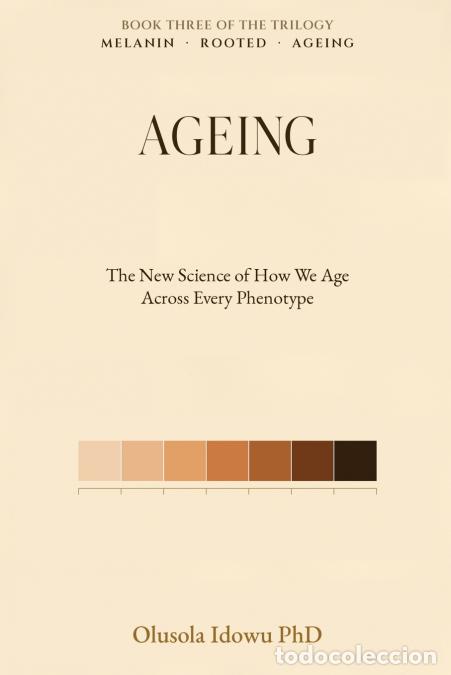
Ageing is the book that explains why, and what the new science of longevity, pigmentation, and dermal structure actually says about how human beings grow old in their skin.
For thirty years, the dominant way of thinking about ageing skin has been a chart called the Glogau scale. It scores faces by how wrinkled they are. It was built on European-descent populations. It is the scale almost every cosmetic clinic in the country still uses. It is also blind to half of what is happening on the faces of half of the population.
Olusola Idowu PhD, an AI scientist and founder of a Newcastle biotech laboratory, has spent fourteen years inside the global anti-ageing industry, watching the gap between what the cellular biology of ageing actually says and what the clinical and cosmetic frameworks still measure. Ageing is his account of that gap, and the integrated phenotype-aware framework that closes it.
Across eleven chapters, readers will discover why Black don?t crack is only half the truth, and what the other half says about the pigmentary face of ageing in melanin-rich skin; why the twelve molecular hallmarks of ageing express differently in European, Asian, and African skin, and what that means for every active in your routine; why retinoids, antioxidants, peptides, and sunscreen do not do the same thing on every face, and how to tell what your skin actually needs; why the scalp and the hair follicle age on their own schedules, and how those schedules interact with the ageing of facial skin; and what the next ten years of longevity skincare, including senolytics, cellular reprogramming, chronocosmetics, and the gut-skin axis, will actually deliver versus what is already hype.
At the heart of the book is the Pigmentary Paradox, an original scientific framework explaining why the very features that defend melanin-rich dermis against wrinkling amplify the pigmentary burden it carries over time, published here for the first time as the sister framework to the Inflammation Paradox introduced in Book Two.
Written in the voice of a brilliant friend who happens to be a scientist and a father, Ageing is rigorous without being cold and personal without losing the evidence. Every claim is grounded in peer-reviewed research and original laboratory work.
The author brings rare authority to the subject. His research has been downloaded more than thirty-one thousand times and sits in the top five per cent of all tracked science. He founded an award-winning AI ingredient-discovery platform and gave evidence to the UK Parliament on AI-driven personalised skincare for melanin-rich populations.
Ageing is the closing book of the landmark trilogy on the biology we share and the differences that matter: Melanin, Rooted, and Ageing.
Read it, and you will never look at your face, your mirror, or the industry built around them, the same way again.
El envío se realizará en 48/72hrs.

Spain (Guadalajara)
Seller registered as a professional.
See more lots about Olusola Idowu

Print on demand books
19,93 €
tc Pay


 Español
 English
 Deutsch
 Français
 Português
 Italiano