


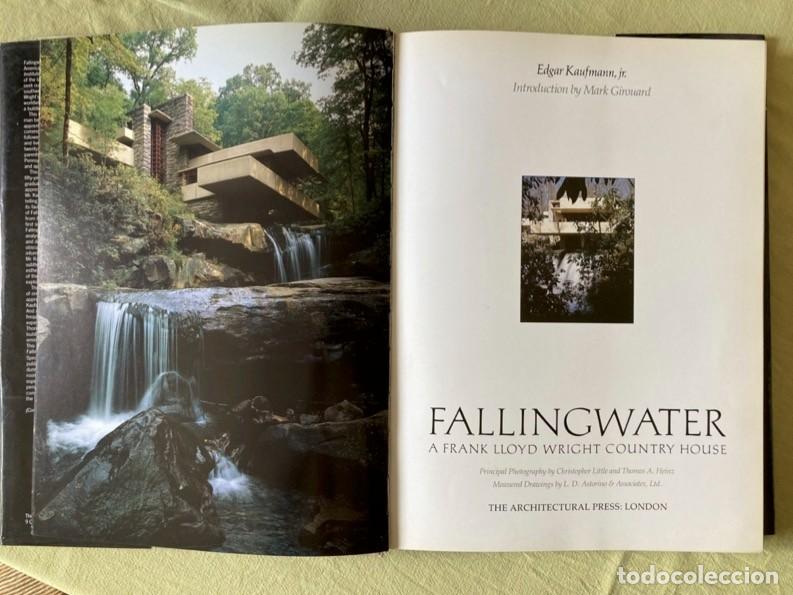
Autor: Edgard kaufmann, jr.
Principal Photography by Christopher Little and Thomas A. Heinz
Measured Drawings by L.D. Astorino& Associates, Ltd
I.S.B.N. 85139-839-1
The Architectural Press: London
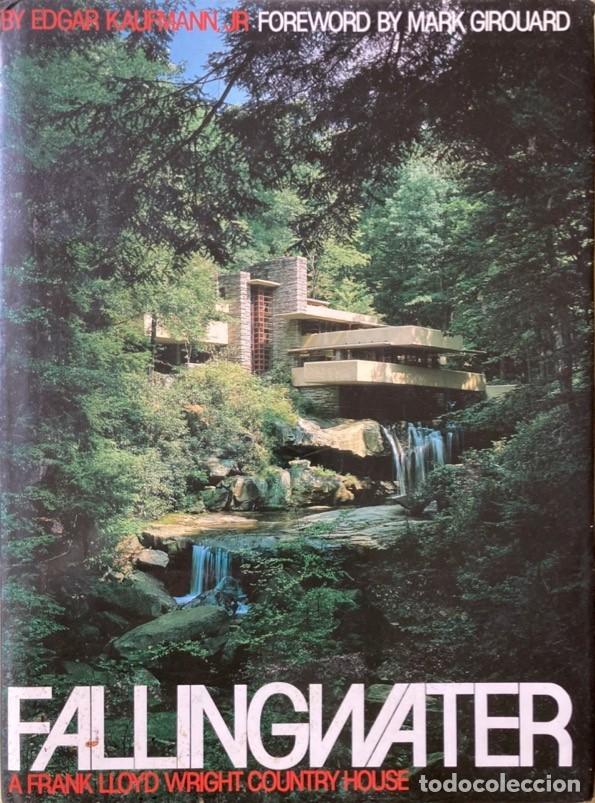
[es] Fallingwater es la casa moderna más famosa de Estados Unidos. ¡De hecho, los lectores del Journal of the American Institute of Architects lo votaron como el mejor edificio estadounidense de los últimos 125 años! Anualmente, más de 70,000 visitantes buscan Fallingwater en su remoto sitio de montaña en el suroeste de Pensilvania. Considera la obra maestra doméstica de Frank Lloyd Wright, la casa es reconocida en todo el mundo como el paradigma de la arquitectura orgánica, donde un edificio se convierte en una parte integral de su entorno natural.
Este libro encantador y provocativo es el trabajo del hombre mejor calificado para emprenderlo, quien fue aprendiz de Wright e hijo del hombre que encargó la casa. Edgar Kaufmann, jr., Siguió de cerca la planificación y construcción de Fallingwater, y vivió en la casa los fines de semana y vacaciones durante veintisiete años, hasta que, después de la muerte de sus padres, dio la casa en 1963 al oeste de Pensilvania Conservancy para mantener el disfrute público y la apreciación.
Este es un registro personal, casi íntimo, de la relación de cincuenta años de un hombre con una obra de genio que solo reveló gradualmente sus complejidades y origenidad. Con pleno aprecio de las intenciones tanto del arquitecto como del cliente, el Sr. Kaufmann describe este notable edificio en detalle, contando sus virtudes extraordinarias pero no de no revelar sus fallas. Una sección del libro se centra en las realidades de Fallingwater como arquitectura. Un edificio famoso desde sus comienzos (solo en parte porque fue la primera comisión significativa de Wright en más de una década), Fallingwater ha acumulado una considerable publicidad y análisis, gran parte de la misma. El Sr. Kaufmann describe y trata los malentendidos comunes que han oscurecido los verdaderos valores del edificio y proporcionan información e interpretaciones precisas. En otra sección, el Sr. Kaufmann proporciona un ensayo en profundidad sobre las sutilezas de Fallingwater, la ideología subyacente a su estética. Un elemento clave de esto es el estrecho entrelazado de la casa y su entorno resistente y desafiante, que explica con detalle fascinante.
El autor mantiene a lo largo del enfoque directo de alguien que conoce y ama Fallingwater. Como aprendiz y fiel admirador del arquitecto, el Sr. 'Kaufmann está bien en sintonía con la arquitectura.
Y como profesor retirado de historia arquitectónica y profesor y panelista frecuente, tiene una experiencia considerable en la presentación e interpretación de las ideas de Wright. Comercialmente versado en los libros, artículos, dibujos y edificios de Frank Lloyd Wright, el Sr. Kaufmann está eminentemente situado para colocar la caída en ese contexto. Este registro único se presenta en la celebración del quincuagésimo aniversario de Fallingwater.
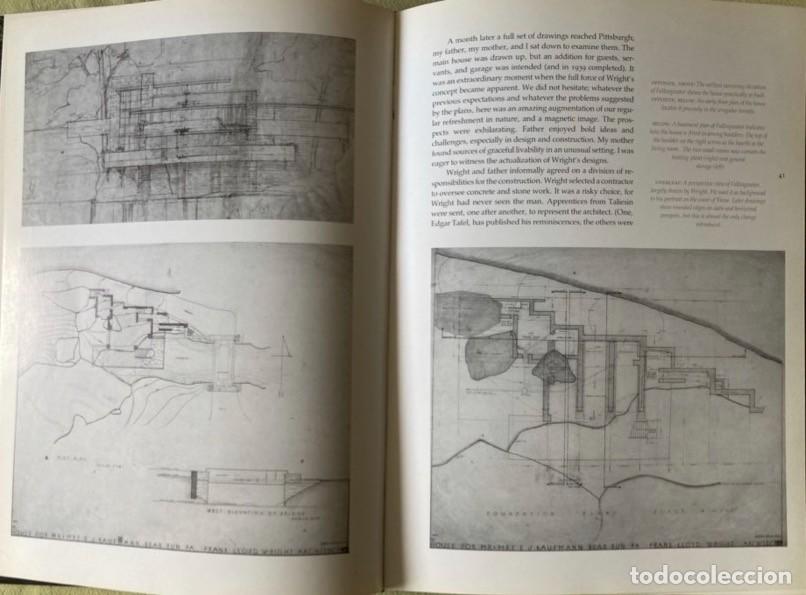
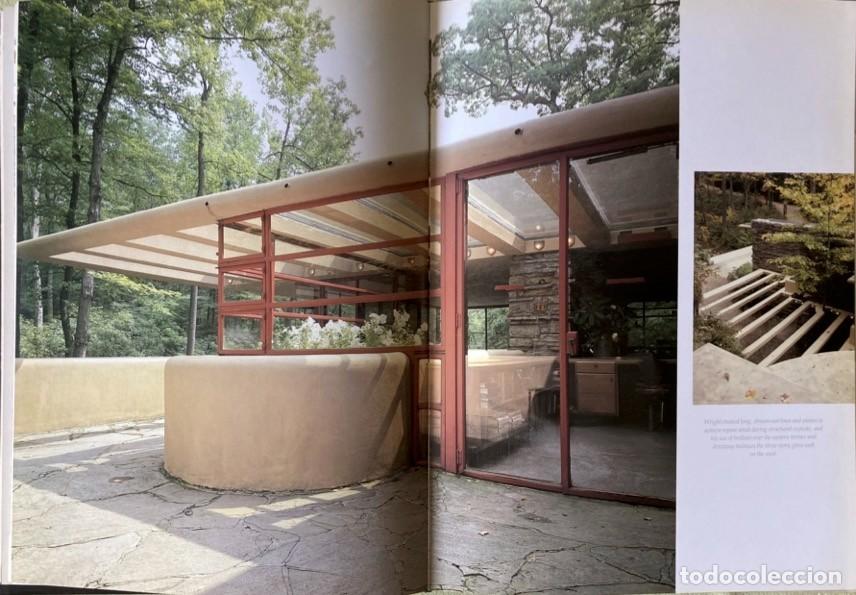
Características especiales de este volumen: numerosas fotografías nunca antes publicadas de la casa en construcción, durante toda su historia y de la familia en residencia; una encuesta pictórica habitual por habitación a todo color que se realiza especialmente para este volumen; Perspectivas arquitectónicas isométricas que explican visualmente cómo se construyó la casa; y los primeros planes precisos y medidos de la casa según lo construido.
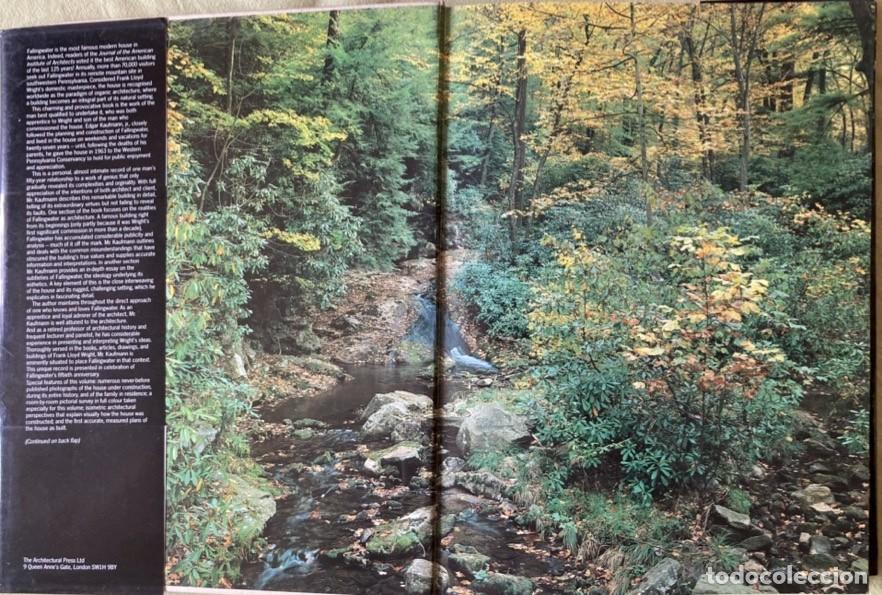
[en] Fallingwater is the most famous modern house in America. Indeed, readers of the Journal of the American Institute of Architects voted it the best American building of the last 125 years! Annually, more than 70,000 visitors seek out Fallingwater in its remote mountain site in southwestern Pennsylvania. Considered Frank Lloyd Wright’s domestic masterpiece, the house is recognised worldwide as the paradigm of organic architecture, where a building becomes an integral part of its natural setting.
This charming and provocative book is the work of the man best qualified to undertake it, who was both apprentice to Wright and son of the man who commissioned the house. Edgar Kaufmann, jr., closely followed the planning and construction of Fallingwater, and lived in the house on weekends and vacations for twenty-seven years - until, following the deaths of his parents, he gave the house in 1963 to the Western Pennsylvania Conservancy to hold for public enjoyment and appreciation.
This is a personal, almost intimate record of one man’s fifty-year relationship to a work of genius that only gradually revealed its complexities and orginality. With full appreciation of the intentions of both architect and client, Mr. Kaufmann describes this remarkable building in detail, telling of its extraordinary virtues but not failing to reveal its faults. One section of the book focuses on the realities of Fallingwater as architecture. A famous building right from its beginnings (only partly because it was Wright’s first significant commission in more than a decade), Fallingwater has accumulated considerable publicity and analysis - much of it off the mark. Mr. Kaufmann outlines and deals with the common misunderstandings that have obscured the building’s true values and supplies accurate information and interpretations. In another section Mr. Kaufmann provides an in-depth essay on the subtleties of Fallingwater, the ideology underlying its esthetics. A key element of this is the close interweaving of the house and its rugged, challenging setting, which he explicates in fascinating detail.
The author maintains throughout the direct approach of one who knows and loves Fallingwater. As an apprentice and loyal admirer of the architect, Mr. ' Kaufmann is well attuned to the architecture.
And as a retired professor of architectural history and frequent lecturer and panelist, he has considerable experience in presenting and interpreting Wright's ideas. Thoroughly versed in the books, articles, drawings, and buildings of Frank Lloyd Wright, Mr. Kaufmann is eminently situated to place Fallingwater in that context. This unique record is presented in celebration of Fallingwater’s fiftieth anniversary.
Special features of this volume: numerous never-before published photographs of the house under construction, during its entire history, and of the family in residence; a room-by-room pictorial survey in full colour taken especially for this volume; isometric architectural perspectives that explain visually how the house was constructed; and the first accurate, measured plans of the house as built.
CONTENTS
The House and the Natural Landscape
A Prelude to Fallingwater In/ Girouard
FOREWORD
Fallingwater, Known and Unknown
RECOLLECTING FALLINGWATER
Drifting Toward Wright 34 How Fallingwater Began
The Faults of Fallingwater
Living with Fallingwater
Responsibilities 61 Rewards and Opportunities
Fallingwater in a New Role
ENTRY AND MAIN FLOOR
Pictorial
REALITIES AT FALLINGWATER
What Fallingwater Is—and Is Not
Measured Drawings
The Adaptability of Wright's Architecture
Wright's Systems—and Mutations
Presenting Continuous Space
Fallingwater in Its Setting
Inside Fallingwater
UPPER FLOORS AND GUEST WING
Pictorial 135
IDEAS OF FALLINGWATER
Images
What Images Do Not Tell
AFTERWORD
Fallingwater's Future
About the author
Edgar J. Kaufmann, jr., after studying abroad for some years, entered Frank Lloyd Wright's Taliesin Fellowship in 1934. During the design and construction of Fallingwater, he often served as intermediary between his parents and Wright. Mr. Kaufmann subsequently joined the Department of Architecture and Design at the Museum of Modern Art in New York, and in 1954 became editorial adviser to Encyclopaedia Britannica, for which he also wrote twelve major articles. In 1963, he began to teach graduate students in art history and architecture at Columbia University, and retired from there in 1980. Mr. Kaufmann is the author, editor, or contributor to several estimable books on design and architecture and has written numerous articles for leading publications in the field of art. He serves on the Editorial Board of the Architectural History Foundation.
Características:
Formato: Tapa dura con sobrecubierta ilustrada
Páginas: 190
Peso : 2.130 gr.
Dimesiones Alto: 33,7 cm Ancho: 24,8 cm. Grosor: 2,9 cm.
Characteristics:
Format: Hardcover with illustrated dust
Pages: 190
Weight: 4,696 lb
Dimensions: High 13,26" Wide: 9,76" Thickness: 1,14"
Fotografias adicionales / Additional photographs:

Spain (Barcelona)


 Español
 English
 Deutsch
 Français
 Português
 Italiano